Quick answer: Driving on a suspended license in Maryland is charged under Transp. § 16-303, and it is a must-appear offense — you cannot prepay it. What it costs depends entirely on why you were suspended. An administrative suspension (§ 16-303(h) or (i), such as an unpaid ticket or an insurance lapse) carries 3 points and a fine up to $500. Every other suspension carries 12 points — enough to revoke a license on its own — plus up to a year in jail.
I’m David Waranch, and I’ve handled thousands of Maryland traffic cases. Most of my clients had no idea they were suspended until the officer told them — an unpaid ticket, a lapsed insurance policy, a missed court date, and then the traffic stop.
The Question That Decides Everything: Why Were You Suspended?
Maryland’s suspended-driving statute, Md. Code, Transp. § 16-303, is split into subsections, and two of them — (h) and (i) — are treated very differently from the rest. Read the table with your own situation in mind, because the practical difference is enormous.
| Administrative suspension (§ 16-303(h) & (i)) | Suspended for cause (§ 16-303(a)–(g)) | |
|---|---|---|
| Typical causes | Unpaid ticket or failure to appear (§ 26-204) · insurance lapse (§ 17-106) · missed a Driver Improvement Program · child-support hold · an out-of-state suspension for an unpaid fine | Point accumulation · a DUI-related suspension · breath-test refusal · most other MVA actions |
| Points | 3 | 12 — enough to revoke on this conviction alone |
| Jail | None (fine only) | Up to 1 year (up to 2 years on a second offense within 3 years) |
| Fine | Up to $500 | Up to $1,000 |
| Court | Must appear — prepayment barred by statute | Must appear |
The point values and penalties above come straight from the statute: § 16-303(k) sets the jail and fine limits, and the point assessments are fixed by § 16-402. If you were suspended because a ticket went unpaid or your insurance lapsed, you are almost certainly in the left column — a fine-capped, 3-point charge. If you were suspended for points or after a DUI, you are in the right column, where a single conviction carries 12 points, and 12 points revokes a Maryland license outright. The first thing I do is establish which column you’re actually in — it changes the strategy completely, and plenty of people are needlessly terrified of a charge that turns out to be the milder one.
This is not a ticket you can pay and forget. Every § 16-303 charge is must-appear, and for the (h)/(i) charges the statute says expressly you may not prepay the fine. Skipping the court date can trigger a bench warrant, and treating a serious-subsection charge as if it were a minor ticket ignores 12 points that revoke your license and real jail exposure. Show up, and get advice before you do.
How an MVA Suspension Turns Into a Criminal Charge
The suspension almost always comes first, and it comes from the MVA — not the court. Understanding that chain is how you defend the charge. A suspension can begin in several ways: you accumulate points and cross a tier (under Maryland’s point system, 8 points in two years triggers a suspension and 12 triggers revocation); your insurance lapses and the MVA acts under § 17-106; you miss a court date or leave a fine unpaid; or you’re hit with an administrative per se suspension after a DUI stop under § 16-205.1 for a breath-test refusal or a result at or above the limit.
Once that suspension is in effect, the moment you drive you’ve committed the § 16-303 offense — whether or not you knew. That’s why fixing the underlying MVA problem matters as much as the courtroom, and why the administrative side often has its own deadlines. A per se suspension, for example, gives you only 10 days to request an MVA hearing that preserves every option (up to 30 days at the outside), and it may open the door to a restricted license or the Ignition Interlock Program. Miss those windows and the suspension hardens, which is exactly what keeps producing new § 16-303 charges.
“I Didn’t Know I Was Suspended.” Does That Help?
I’ll answer this straight, because almost every client asks and most sites talk around it. Section 16-303 does not give you an express “I didn’t know” defense the way the uninsured-driving statute does. So no, you can’t simply say you were unaware and expect the charge to vanish.
But lack of proper notice matters more than that flat answer suggests, and it’s one of the most common genuine defenses on this charge. The MVA sends notice to the address it has on file. If you moved, if the notice went to an old address, if the suspension arose from something you were never actually told about, that goes to what the State can prove — and to how a judge sees you. Someone who defied a known suspension and someone who genuinely never received notice get very different outcomes in the same courtroom. So gather what you have: your address history, anything showing the notice never reached you, records of when the insurance actually lapsed. It’s evidence, not an excuse, and it’s often what turns a conviction into something better.
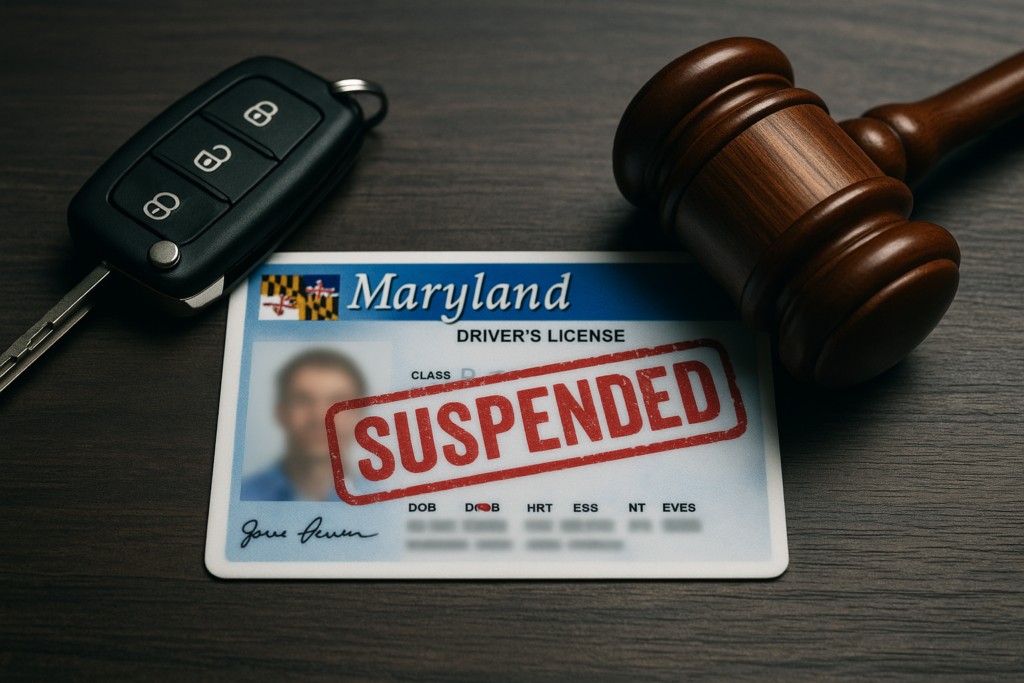
Suspended, Revoked, Canceled — and Never Licensed at All
These words get used interchangeably, and they aren’t interchangeable. A suspension is a temporary withdrawal of your privilege — it ends, and you get the license back once the conditions are met. A revocation terminates it: there’s a waiting period, and then you must affirmatively apply for a new license. A cancellation voids a license issued in error or no longer valid, and driving without ever being licensed is a different charge entirely under § 16-101 (see driving without a license). Which one you’re facing changes the road back; I’ve broken it all down in suspension vs. revocation vs. cancellation.
How I Defend a Suspended-License Charge
Two things happen in parallel, and they have to be handled together.
The criminal case. I check which subsection you’re actually charged under, whether the State can prove the suspension was properly in effect and noticed, and whether the stop itself was lawful. Where the facts are hard, probation before judgment under Crim. Proc. § 6-220 can keep the conviction — and the points — off your record entirely.
The underlying problem. This is the part people skip, and it often decides the case. If you’re suspended for an unpaid ticket, we pay it. If it’s an insurance lapse, we get coverage reinstated and the MVA penalty resolved. If it’s a missed court date, we address the missed date too. Walking into court with the suspension already cleared is a completely different conversation from walking in still suspended — judges notice. And whatever you do, do not keep driving. A second charge while the first is pending is the fastest way I know to turn a manageable case into a serious one.
Why Work With Me
I’m in traffic court most days of the week. I know how these charges are treated county by county, how the MVA side interacts with the court side, and how to get the underlying suspension actually lifted rather than just surviving the hearing. I’ll give you a straight answer about where you stand, including when a case isn’t as bad as you feared. For the full picture, see my Maryland license & MVA issues guide or the broader Maryland traffic violation overview.
Frequently Asked Questions
It depends on why you were suspended. If the suspension came from an unpaid ticket, a failure to appear, an insurance lapse, or a missed Driver Improvement Program under § 16-303(h) or (i), it is 3 points. For any other suspension it is 12 points, which is enough on its own to revoke your license.
For a § 16-303(h) or (i) charge the statute sets a fine of up to $500 and no term of imprisonment. For every other subsection jail is legally available: up to one year on a first offense and up to two years on a second within three years. Available is not the same as likely on a first offense handled properly, but it is real exposure.
You have to go to court. Driving on a suspended license is a must-appear charge, and for a § 16-303(h) or (i) violation the statute expressly bars prepaying the fine. That court date is also your chance to fix the case, so do not miss it.
Find Out Which Charge You’re Actually Facing
The difference between a 3-point, $500-capped charge and a 12-point charge carrying a year of jail exposure is the whole case, and it turns on a detail most people don’t know to ask about. A short conversation will tell you which one you’re facing, what a realistic outcome looks like, and what we need to fix before your court date. The consultation is free, and there’s no reason to spend another week not knowing.
Law Offices of David R. Waranch — 301-563-9575 · toll-free 1-877-566-2408. Hablamos Español.
Last updated: August 2026. Statutory references: Md. Code, Transp. §§ 16-303, 16-402, 16-205.1, 17-106, 26-204, 27-101; Crim. Proc. § 6-220. This page is general information about Maryland law, not legal advice, and reading it does not create an attorney-client relationship.