
Quick answer: What matters first is whether the officer checked the payable box. A payable citation gives you 30 days and four ways to respond under Md. Code, Transp. § 26-201(c)(1) — and mailing in the preset fine is one of them, which is a guilty plea that puts a conviction and its points on your record. A must-appear citation has no preset fine at all. Points are assessed under § 16-402 and counted over a rolling two-year window under § 16-404.
I’m David Waranch, and I’ve handled thousands of Maryland traffic cases — from an $80 speeding ticket to charges carrying 12 points and a revocation.
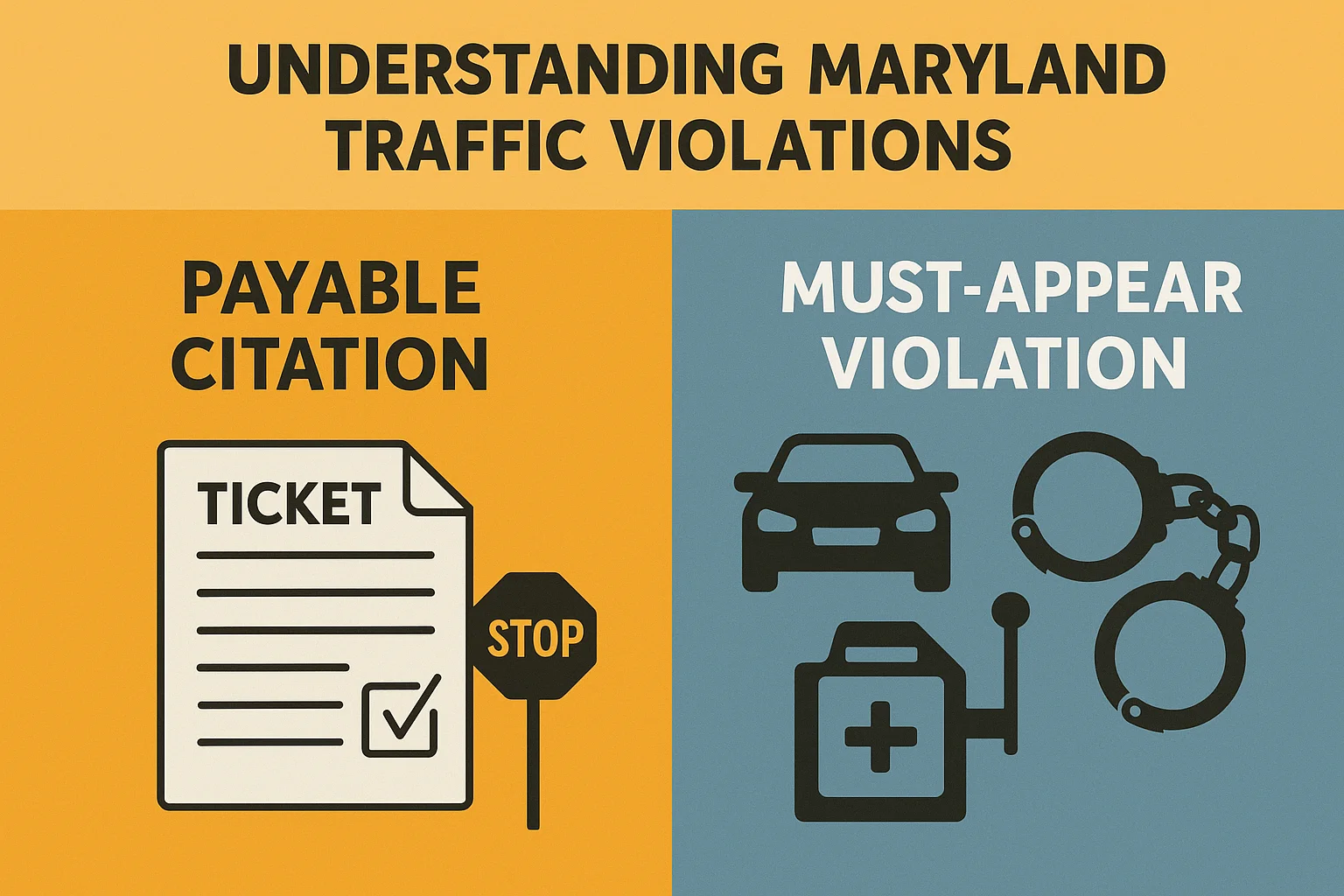
Understanding Maryland Traffic Violations
Maryland traffic charges split into two groups, and the split is not about how bad the driving was — it is about what the officer marked on the citation. A payable citation carries a preset fine from the District Court’s fine schedule: a routine speeding ticket, a rolling stop, a red light. A must-appear citation carries no preset amount, because it cannot be resolved by mail — driving on a suspended license, reckless driving, driving uninsured, DUI or DWI, leaving the scene.
If your citation is payable, § 26-201(c)(1) requires it to print in boldface that within 30 days of receiving it you must: pay the full preset fine; enter a payment plan under Cts. & Jud. Proc. § 7-504.1 if you qualify; request a hearing on sentencing and disposition in lieu of a trial (the waiver hearing); or request a trial date. Payable versus must-appear tickets in Maryland covers each deadline in detail.
Option one is the reflex, and it costs the most. It forecloses probation before judgment under Crim. Proc. § 6-220, where the court stays entry of judgment so that on discharge there is no conviction and — because § 16-402(a) assesses points only “after the conviction” — no points either. Why paying a Maryland traffic ticket may not be a good idea is the full argument.
Common Traffic Offenses and Their Penalties
Here are the charges I see most often, with what each is worth. Fines are the District Court’s preset amounts (DC-CR-090, Rev. 10/2025); point values come from § 16-402(a). “Must appear” means no preset fine and no prepayment — the case goes in front of a judge.
| Offense | Statute | Preset fine | Points |
|---|---|---|---|
| Speeding | Transp. § 21-801.1 | $80–$530 by speed range | 1–6 |
| Failure to stop at a steady red signal | Transp. § 21-202(h) | $140 | 2 |
| Negligent driving | Transp. § 21-901.1(b) | $350 | 2 |
| Aggressive driving (3+ listed violations at once) | Transp. § 21-901.2(a) | $500 | 5 |
| Reckless driving | Transp. § 21-901.1(a) | Must appear | 6 |
| Knowingly driving an uninsured vehicle | Transp. § 17-107(a)(1) | Must appear | 5 |
| Driving without a required license | Transp. § 16-101(a)(1) | Must appear | 5 |
| Driving on a suspended or revoked license | Transp. § 16-303(a)–(d) | Must appear | 12 |
| Failure to stop after an accident involving bodily injury | Transp. § 20-102(a) | Must appear | 12 |
| Driving while impaired by alcohol (DWI) | Transp. § 21-902(b) | Must appear | 8 |
| Driving under the influence (DUI) | Transp. § 21-902(a) | Must appear | 12 |
Speeding is worth breaking out, because the jumps between tiers are steep.
| Miles per hour over the limit | Preset fine | Points | If it contributed to an accident |
|---|---|---|---|
| 1 to 9 | $80 | 1 | $120 / 3 points |
| 10 to 19 | $90 | 2 | $130 / 3 points |
| 20 to 29 | $160 | 2 | $200 / 3 points |
| 20 to 29 over a posted 65 or 70 mph limit | $290 | 5 | $290 / 5 points |
| 30 to 39 | $290 | 6 | $290 / 6 points |
| 40 and over | $530 | 6 | $530 / 6 points |
Watch the 30 mph line. At 30 over, speeding is a six-point offense under § 16-402(a)(28) — the same value as reckless driving, and half the way to a revocation on its own. It is also the threshold the fine schedule uses for reckless driving as a must-appear charge, so one stop can produce either a payable citation or a court date. Penalties by speed range has the full breakdown, and a Maryland speeding ticket lawyer can tell you which side of the line you are on.
“It’s only $90 — I’ll just pay it and be done.” That $90 is the cheapest part of the ticket. Paying a preset fine is a guilty plea. It creates a conviction on your Maryland driving record, adds the points listed above, and gives up probation before judgment under Crim. Proc. § 6-220 permanently. Requesting a waiver hearing or a trial keeps a non-conviction disposition on the table. That is a real trade-off rather than a free option — the Maryland Judiciary warns that at either hearing “there is a possibility that your fine could be increased, up to a maximum of $500” — but it is a trade-off you should make on purpose, not by mailing a check.
The must-appear charges are a different category, and several are criminal as well as administrative. Driving while suspended or revoked under § 16-303 carries 12 points — the revocation threshold by itself; see driving while suspended in Maryland. Hit and run under § 20-102 is also 12 where there is bodily injury; uninsured vehicle under § 17-107 is 5. DUI or DWI brings a parallel MVA case on top of the criminal one, and some stops produce criminal charges unrelated to the Vehicle Law. Negligent driving sits in between: payable at $350, and often the charge a more serious case negotiates down to.
One more number. Where the Vehicle Law sets no penalty of its own, § 27-101 makes the violation a misdemeanor and caps the fine at $500 on conviction at trial. The preset amount and the statutory maximum are different figures, and the gap matters when you choose how to respond.
What the Points Actually Do to Your License
Points are assessed only on conviction, and § 16-402(a) dates them to the day of the violation, not the day you were found guilty. Under § 16-404(a), points accumulated within any two-year period trigger a warning letter at 3, a mandatory driver improvement program at 5, a suspension at 8, and a revocation at 12. Maryland’s point system in a nutshell covers the thresholds and the hearing rights attached to each.
Two things people get wrong. First, the two-year window governs how long a point counts toward MVA action; it is not a promise the conviction disappears — see how long a Maryland ticket stays on your record. Second, points are an MVA currency, not an insurance one: your carrier prices the conviction itself, on its own timetable, as how insurance companies treat traffic convictions explains. Hold a commercial license and a conviction in your personal car can still reach your CDL.
How an Experienced Maryland Traffic Violation Lawyer Can Help
My goal in almost every case is the same: keep the conviction and its points off your record. That is narrower than “winning,” and achievable far more often, because Maryland gives a judge several ways to end a case without a conviction. Probation before judgment under Crim. Proc. § 6-220 is the main one — on fulfillment of the conditions the court discharges you, and that discharge “is not a conviction for the purpose of any disqualification or disability imposed by law.” A reduction, a dismissal on a proof problem, or a nolle prosequi reaches the same place.
Getting there starts with the paperwork. I read the citation against the code section actually charged, the officer’s notes and the circumstances of the stop, because a surprising number of citations have something wrong with them: the wrong subsection, a posted limit that is not what the citation says, observations too thin to prove an element. Radar speeding tickets turn on calibration and operator training that must be established in court, not assumed.
For most payable offenses I can appear in court for you, which matters when a day off work costs more than the ticket. The choice between a waiver hearing and a trial is strategic: a waiver hearing concedes the facts and asks for a better disposition; a trial puts the State to its proof. Either way the judge can raise the fine.
Counties We Serve in MD
I handle traffic cases throughout Maryland. Practice varies by courthouse — what a prosecutor will agree to, how a bench treats a first offense — so local familiarity is worth something. Start with your county:
- Anne Arundel County
- Baltimore County
- Baltimore City
- Carroll County
- Cecil County
- Charles County
- Frederick County
- Harford County
- Howard County
- Montgomery County
- Prince George’s County
Deadlines, and What Happens If You Miss One
Ignoring a citation is the one response with no upside, and the consequences sit in Transp. § 26-204 rather than in anyone’s discretion. Fail to comply with the notice on the citation or with a trial notice and subsection (c) lets the court issue a warrant for your arrest, or — after five days — notify the MVA.
Once the MVA has that notice, subsection (d) requires it to tell you your driving privileges will be suspended unless you comply by the end of the fifteenth day after the notice is mailed. That is a suspension, not a restricted license, and it stacks on whatever the original charge was worth. Drivers regularly come to me holding a § 16-303 charge — 12 points, must appear — that began as a $90 ticket they meant to deal with. What happens if you ignore a Maryland speeding ticket traces the sequence.
One practical rule: note the date you received the citation, not the date printed on it, because the 30-day clock in § 26-201(c)(1) runs from receipt.

Why Choose David R. Waranch for Traffic Defense
Traffic is what I do, and I am in Maryland traffic courts regularly rather than occasionally — so I know which charges a prosecutor will reduce and when a case is worth trying. If you are holding a citation and the 30 days are running, contact me for a free consultation, or call. Have the citation in front of you: the code section on it drives everything, and I can usually tell you in a few minutes whether you have a fine problem, a point problem, or a license problem. My Maryland traffic lawyer homepage covers the practice generally.
FAQs About Traffic Violation Attorneys in Maryland
Check whether the officer marked it payable. If it is payable, Maryland Transportation Article Section 26-201 gives you 30 days from receipt to pay the preset fine, request a payment plan, request a waiver hearing, or request a trial. Do not pay it before you understand what it costs you, because paying a preset fine is a guilty plea and puts a conviction and its points on your driving record.
Often, yes. Points are assessed only on a conviction, so any disposition that avoids one also avoids the points. The main route is probation before judgment under Criminal Procedure Section 6-220, where the court stays entry of judgment and discharges you on completion of the conditions. A reduction to a lesser charge or an outright dismissal has the same effect. Paying the ticket gives all of that up.
It depends on the charge. For most payable offenses your lawyer can appear for you. Must-appear charges such as driving on a suspended license, reckless driving, driving uninsured, DUI and leaving the scene of an accident have no preset fine and cannot be resolved by mail, and the court will usually expect you there in person.
Under Maryland Transportation Article Section 26-204, the court may issue a warrant for your arrest or, after five days, notify the MVA that you did not comply. The MVA then warns you that your driving privileges will be suspended unless you comply by the end of the fifteenth day after that notice is mailed. Driving after that suspension takes effect is a 12-point must-appear charge.
Under Maryland Transportation Article Section 16-404, the MVA acts on points accumulated within any two-year period: a warning letter at 3 points, a required driver improvement program at 5, a suspension at 8, and a revocation at 12. Points are dated to the day of the violation rather than the day of conviction.
Law Offices of David R. Waranch — 301-563-9575 · toll-free 1-877-566-2408. Hablamos Español.
Last updated: August 2026. Statutory references: Md. Code, Transp. §§ 16-101, 16-303, 16-402, 16-404, 17-107, 20-102, 21-202, 21-801.1, 21-901.1, 21-901.2, 21-902, 26-201, 26-204, 27-101; Md. Code, Crim. Proc. § 6-220; District Court of Maryland preset fine schedule DC-CR-090 (Rev. 10/2025). This page is general information about Maryland law, not legal advice, and reading it does not create an attorney-client relationship.